William Paul and Maycle Olivia Scott
Early Life
The first things I would tell anyone about my paternal grandfather, William Paul Scott, is that he survived a snake bite, a gunshot wound, and he helped build the first atomic bomb. That's quite a trifecta of unusual events for one person's life, and while each event is entirely true, the context of these extraordinary events isn't nearly as dramatic as one might think.
Paul Scott was born April 24, 1911 and was the twelfth child of Green Lee Scott. Green was 47 when Paul was born, and Green's second wife, Roberta Caroline (Mann) was 35. The first four children in the Scott clan were born by Green's first wife, Elizabeth Ann (Boyd). She died several days after the birth of her 4th child, Bennet Boyd Scott. That gave Paul two half brothers, James and Ben, and two half sisters, Clyde and Della. Roberta Caroline, or Carrie, created a family rich in daughters, and Paul's full sisters were named Eva, Amanda, Pearl, Faye, Hazel, Jessie and Ruby. The family rounded out with one more child after Paul, John Keith Scott.
I spent a lot of time with my grandparents and feel lucky because I was their first grandchild. They spoiled me with attention and kindness and made me feel special. I also came into their lives when they were raising their last child, Stephen Paul, and had finally scrimped and saved enough to afford a partnership with their two eldest sons to purchase the family farm from Paul's half brother James Emmette Scott, who always went by Pete (for some reason.) It was the first home they owned.
Census records show that the farm on Hungards Creek during Paul's life was full of brothers and sisters and, at least one border. My Aunt Faye told the most stories about him as a young boy among a bevy of sisters, particularly how they would dress him up and curl his hair. Who needs a baby doll when a baby brother is available? Paul also related many stories about life on the farm, all very happy, and to me, even idyllic. He did not talk about discomfort, hunger, disease or terrible misfortune. They farmed with horses, raised pigs and cows, milked a cow, kept chickens, gardened and raised peaches and apples that he swore were sweeter than anything we can presently acquire in a grocery store.
While most farm families were land rich and cash poor, the Scott's, at least early in Paul's life had some cash enterprise in the form of a steam saw and grist mill. The mill had come to farm in the previous generation from Green Lee's father, James Kincaid Scott. Paul was well versed in the commercial value of various wood types and could identify every tree on the property. He was also educated on the farm, as the Scott's had built one room school house in the bend of Hungards Creek which served the children living in that particular creek valley. In all, I believe he had seven years of formal education. I knew him to read a newspaper frequently.
A Degression Upon Snakes
While his memories of farm life were almost always positive, the snakebite was a frightening aspect of farm life. He would take off his shoe and sock and show the location on his foot where, as barefoot child of 8 years of age, he stepped on a serpent while on the creek bank. The scars from event were there to see, although what was visible might have been more from the ensuing primitive treatment of cutting and bleeding the affected area than the bite itself. A physician was brought to the home and sliced into the bite area to release "black blood", as grandpa put it. It was the physician's opinion, based on the bite marks, that the snake was a cotton mouth water moccasin (which is not likely, as they are not know to be anywhere near southern WVA. ) Most likely, it was a copperhead, which is the most common venomous snakes found in the area, and there was no account of a rattle, which would have unmasked another possible culprit and the localized reaction to the bite was more typical of a copper head.
Snakes, in general, were not well regarded by Scotts living on Hungards creek. They were evil creatures who contributed to the downfall of man owing to the serpent's part in tempting Adam and Eve in the Garden of Eden. Personal run ins with venomous varieties did nothing to rehabilitate their image, and perfectly harmless varieties were guilty by association. If a snake was seen, it was killed with whatever bludgeon, tool, gun or rock was available.
On one summer visit, Granpa, then about 60 years of age, was walking back toward the front porch in a low spot in the yard when he whooped and jumped as if he suddenly was possessed by a younger spirit. He had once again stepped on snake which he claimed wrapped around his leg and attempted to bite him. Unlike the 8 year old barefoot Paul, this version was wearing thick leather work boots which were perfect stomping the snake to death.
It turned out not to be a particularly big snake. Small actually. There was speculation about it being a rattlesnake and an earnest attempt to more precisely identify the species ensued. Aunt Faye and Danese had invested in a set of encyclopedias and did have the "S" volume with several pictures of rattlesnakes. They settled on the pygmy rattler as the likely species because of the three grainy black and white photos of rattlers, it looked most like the pygmy rattler. I actually don't recall that snake having any rattles at all and none were collected.
I saw him kill a five foot black snake with garden hoe. The snake had a large bulge in its midsection and he opened it with a machete and found a small rabbit. He almost always carried some manner of bludgeon around just in case or used a shot gun on such intruders if the snake was close enough to the house where he could easily grab the loaded 20 gauge. If it wasn't clear enough by his actions how he felt about snakes, all one had to do is listen to the stories they told which amplified the evil nature of snakes as aggressive animals intent on causing harm.
Tales of blacksnakes breeding with copperheads creating a poisonous hybrid were common. Water skiers on Bluestone lake inadvertently water skiing into a nest of venomous water vipers resulting in fatal and horrific family trip were among the scariest and saddest of tales. They could drop off of trees, or secretly invade the personal parts of the home. You were never really safe from'm. Stories were passed from front porch to front porch and everyone had a tale about an encounter. Such was the nature of evening conversation on the farm.
The West Virginia State fair had a Snake Lady. Sometime in the early 1960's, Aunt Faye and Danese made their way to Lewisburg to take in a day at the fair and the Snake Lady was on their list of things to see. Once inside this popular sideshow, the found themselves looking down into circular pit in which a woman was dressed in a fancy performance outfit and draped with a relatively harmless boa constrictor spoke of her connection to snakes. In the dimly lit pit their appeared to be many other wriggling and slithering creatures. For people who had a pathological fear of snakes, this spectacle had to be nerve wracking. I'm sure the performer was well versed in reading the crowd and especially honing in on those who appeared to be most terrified of the unusual situation. Apparently Aunt Faye's body language gave away her discomfort and when it came time to engage the crowd by flipping one of the floor serpents out of the pit and at a viewer, Aunt Faye was targeted. She laughed about it later, because it turned out to be a piece of black rubber, but the crowd got there nickel's worth out of her reaction.

This excerpt was like published in the Monroe Register in 1870 or so, which shows how a good snake story often got into the paper. Given the time frame and the reporting on the children's ages, the likely two Scott children were Lyskins Louise Scott and her little brother, Green Lee. Green Lee is the father of Paul Scott, and this account has living on Wolf Creek in Monroe County West Virginia prior to moving to Hungards Creek. This particular story was passed from The Monroe Register one to a Morgantown newspaper.
Dealing with Varmints
People living today have a totally different perspective on wildlife and pets. As my ancestors moved into the wild frontier, their margins for food production and harvest were far more narrow and precarious, and their tolerance for any animal that may have negatively affected that fine balance was non existent. Anything that could disturb a garden was eliminated, and, to be sure, in the very early days of settlement such creatures had the added value of being food sources. I am sure the earliest ancestors in Monroe County would not turn their noses up a groundhog, raccoon or possum. I'm not saying they were tasty fare, but giving the circumstances, a little wild protein might have been necessary and welcome.
Aside from snakes, the animal that drew the most ire was the groundhog. Despite being universally despised, these creatures still managed to proliferate in large numbers and were regular invaders. (Ironically, clearing land to pasture provides a better habitat for these creatures than the forested hillsides.) Aside from occasionally ravaging the garden, their burrows were said to pose a great risk to livestock who would step into the holes an damage or break legs. Paul kept two loaded guns in the front bedroom, right behind the master bedroom door for quick access should he need to defend the farm.
One summer a ground hog chose to burrow across the creek right in front of the house, and would sometimes climb a large white mulberry tree on the bank of the creek. This would disturb the peace of evening and send Paul into the bedroom for the rifle and, if he was lucky, he could squeeze off a shot before the groundhog got wind of human activity. He missed that particular groundhog, but I have seen him take one out from 100 yards away. Paul had good eyesight all of his life and was a good shot. Any groundhog who dared show his fur was lucky to escape.
A more common way of dealing with the problem was with leg hold traps. On one occasion of a summer visit he discovered that a burrow which went under the barn. He installed a leg hold trap at the entrance of burrow hoping the resident would spring it as it exited. This was just the situation we found the next morning as the poor creature had become entrapped, but not killed. Granpa grabbed a sufficiently large piece of would and clubbed the groundhog one or two good swings to the head until its eyes popped out. It was my first experience with this kind of dispatch. Granpa didn't mess around with varmints like that, or squirrels, for that matter. The first squirrel I hunted was shot from a nest and bounded away only to be clobbered over the head trying to escape. My Uncle Steve cleaned it and a couple others and my grandmother fried'm up and made gravy from the dripping and cooked biscuits to go go with it.
Hunting
Squirrels were about the only game available in the 1960's, The dearth of deer, bear, turkeys and other game animals was inevitable consequence of over hunting and loss of habitat. There were not even very many rabbits. Every marketable tree was cut, forests were cleared for pastures and game was taken without regard to season or reproductive cycle. After World War 2, States began to better manage hunting for sustained populations of wildlife and developed methods for species reintroduction into wildlife refuges. The forests were regenerating as well.
Today, West Virginia has the third highest percentage of tree cover of any State. The bulldozed and rocky strip mines of Raleigh and Fayette Counties have all been covered with the help of reclaimation and the natural succession of plants in disturbed places. By the 1970's a small population of deer had returned and they were occasionally seen in the fields, or their tracks were observed in snow. By the 1980's wild turkeys had also returned. In about 1987 I took one my last walks on the property and observed many deer and turkeys, and a vibrant maturing forest which had been untouched for decades. Bear and coyotes are now common, and collisions of deer with cars does as much to manage their population as hunting. Bald Eagles and other raptors have returned as the ecosystem now supports a diversity of animal life.
Work and Family
My grandfather's was the first generation to seek work off the farm. James Scott of the Sinks, his son Williams Robert and his James K. Scott were all farmers. When James K. Scott settled the land on Hungards Creek, he farmed, but also ran a steam saw and grist mill. Green Lee inherted and benefited from the saw mill, but at some point either it or the timber gave out and farming again was the primary economic activity. Emmett Scott had learned how to work a steam engine and used this knowledge to get a job on the steam railway. He was the first to seek work off the farm. Paul Scott was familiar with all farm and mill work, but followed in the footsteps of his older half brother Emmett and found work on the C and 0 railroad. This is where he learned the electricians trade and is how he made a living for his entire adult life. He was a member of the International Brotherhood of Electrical Workers (IBEW) and got a small pension from the railroad when he retired.
 |
| Maycle is women on the right leaning in. Her brother James Hedrick (Heggie) is the round faced boy with glasses |
A big part of Paul's comfort and success in life was marrying well. Maycle Olivia Light was the second child of Ada Light (Hedrick) and Elias Light. She was born July 31st in 1911. I don't know much about his courtship or how he met of Maycle, but I think it involved a Friday bath and a long walk from the farm to Talcott. Though Maycle lived in Avis, Ada's side of family was from Talcott and I think Maycle was there frequently.
.jpg) |
| Hinton Daily News, June 3, 1933 |
Paul and Maycle were married on June 1st of 1933 in Lewsiburg, WVA. William Randolph Scott was born on June 1st of 1934 and as small child would innocently tell company that his parents were married the very day he was born. I was lucky to find this image of my infant father and proud very young grandmother.

Maycle took care of everything within the home. To be sure, with a bunch of older sisters in the home who took care of all the cooking and kitchen duties, Paul seldom had need or any expectation to have knowledge in this area. He probably knew how to stoke a steam engine boiler, but a pot of boiling water on the stove, not so much. I'm not even sure he could scramble or fry an egg. I never, ever, saw him independently get anything from the kitchen and I suspect he didn't even know where to look. Grama trimmed his toe nails, fetched snacks, washed and ironed his clothes and made sure he had breakfast and packaged a lunch with a fresh pack of cigarettes and thermos of coffee.
She would arise every morning long before he awakened to cook his breakfast and lunch. Coffee with half and half and sugar was on the breakfast table, along with his Raleigh Filters. The evening meal was always ready when he returned home. She was a a skilled cook and knew what he liked and made sure he had plenty of it. In the evening, snacks were fetched for him so he didn't have to get off the couch. She also handled all appointments they needed to make and balanced the check book.
The Depression and Work
 |
| Ranny and Jack with their Aunt, Willie Light circa 1940 before moving to Oak Ridge |

Not only where they living in tight quarters, but in December of 1940 Maycle had baby Jerry Lynn. I am not sure they would have ever mentioned or spoken of Jerry had we not seen his headstone on a visit to family plots at the Oak Grove cemetery, possibly during Grama Ada's internment in December of 1970, He died in April of 1941, barely 5 months old. No definite diagnosis was given, but possibly some kind of blood cancer and an acknowledgement that he was just a sickly little baby. My father was only five years old, and Uncle Jack was only 3, so they did not remember much about that time period.
Building the Atomic Bomb
World War 2 provided opportunities for work in a way he would not have predicted. In 1942 the US government was operating on a war economy and purchased 60,000 acres in Tennessee. It was rural, but also benefited from an abundance of electrical power from recently completed electrical generation projects from the Tennessee Valley Authority. In addition, the government began recruiting all manner of labor to support some unknown but massive project. By this time the prospects for laborers had shifted from one of chronic unemployment to choice of opportunities. The US government was faced with a recruiting problem in which skilled had many choices in an economy that was gearing up for full time war production.
It's plausible that Paul heard about this opportunity through his IBEW membership. While the US government wanted full control over labor involved in their super secure secret project. Unions provided a ready list of qualified and skilled workers. Unions not only advocated for fair and safe working conditions, but had structed and comprehensive training programs which certified skill levels in particular trade or craft, and Oak Ridge needed skill electricians, pipefitters, welders and plumbers to undertake designs that required great attention to detail and safety. They wanted skilled Union workers, but the workers and Unions were forbidden to organize at the government sites.
To make Oak Ridge attractive to workers that now had choices, they were able to offer several incentives. They paid a little higher wage than the prevailing scale for a given trade. They also promised housing in a secure community and extended the offer to whole families, so not only could the husband work, the family would find a subsidized home as well. They sold Oak Ridge as community in which parks, theaters, stores and schools would all be part of the package deal. They would also provide laundry services. If education was important, they offered families the opportunity for an extended public school education to the age of 18 during a time when most southern children who finished a public education did so by the age of 14. The government made it clear that the work would be "supporting our boys overseas", so there was a patriotic element to it. I think the patriotic aspect was a big deal to my grandfather. Well into his senior years he was reluctant to embrace any Japanese technology and said pretty clearly, "them Japs done us pretty dirty."
By 1942 or early 1943, Paul was taking advantage of this opportunity and moved the family to the site. They lived in a small trailer. My father, Ranny, was nine and my Uncle Jack would have been seven. My father recollected school and living in the trailer park and particularly wooded side walks that were constructed to prevent slogging through the perpetual mud of quickly constructed roads and neighborhoods. The history of Oak Ridge shows that the government took the promise of education seriously and hired well qualified administrators and teachers to create curriculum and work with an entire community of relocated people.
While the promises of housing and education were generally kept, accounts of the time period tell of the unconvince of living in the community as the particulars of service were sorted out. Laundry was sometimes lost, the roads and walkways were a muddy mess, or a dusty one, food was not always abundant in the stores. I suspect that their routine included my grandmother rising a couple of hours before everyone else before the sun came up. She would prepare my grandfather's breakfast and lunch. If she had an oven, she would bake biscuits. If not, she could create fried apple pies with applesauce, flour and lard and they would boil oats for breakfast. If there was a salted ham, grampa would eat thinly sliced on a biscuit everyday, and be perfectly fine with it. He would get up in the morning, find the food at the breakfast table, have a couple cups of coffee with lots of sugar and cream and four or five Raleigh Filters, grab his lunch pail, and head out for a long day of work with a caffeine and nicotine buzz. When he returned in the evening, dinner was only a few minutes from the table.
 |
| Ranny is pudgy one, Jack the skinny little fellow Probably taken in '43 or '44. Little girl is not know. |

 |
| 1944 Oak Ridge Gamble Valley Trailer Park & Super Market |
By 1945 Oak Ridge had 75,000 residents and still was a secret city. I asked my grandfather if he was aware of what was going on there and he said until the bombs were dropped to end the war, he really had no idea. They were not allowed to speak the work place or what was going on and were told just tell people " we are making blue mud". Since my education and background included some knowledge of nuclear technologies, I also asked if he was aware of ever being exposed to radiation. This is paraphrasing of what he said: "From time to time some of the "longhairs" would come into a building holding some kind of instrument and they would go around the place and seemed to be checking for something. Once they were done, we would go back to work. I never did know what they were looking for."
Sounds like technicians with Geiger counters to me, and it's possible that he was exposed to some ionizing radiation, but he did not recall any personal radiation monitoring devices and the science that ultimately created regulations only fully developed in the decades that followed.
My father remembered being in Oak Ridge when the war in Europe ended, and then when the Japanese surrendered after the Atomic bombs were dropped. That's when they learned they had been part of the Manhattan Project. During the Carter administration, Grama and Granpa were surprised to receive a certificate of appreciation for work done Oak Ridge. It was signed by President Jimmy Carter and was displayed in the dining room of their home Hungard's Creek. I am very sorry that it was not preserved for posterity. It was a very important part of global history. They looked back on the experience fondly, but they were always destined to return to West Virginia when opportunities presented themselves. Once again the US government provided one.
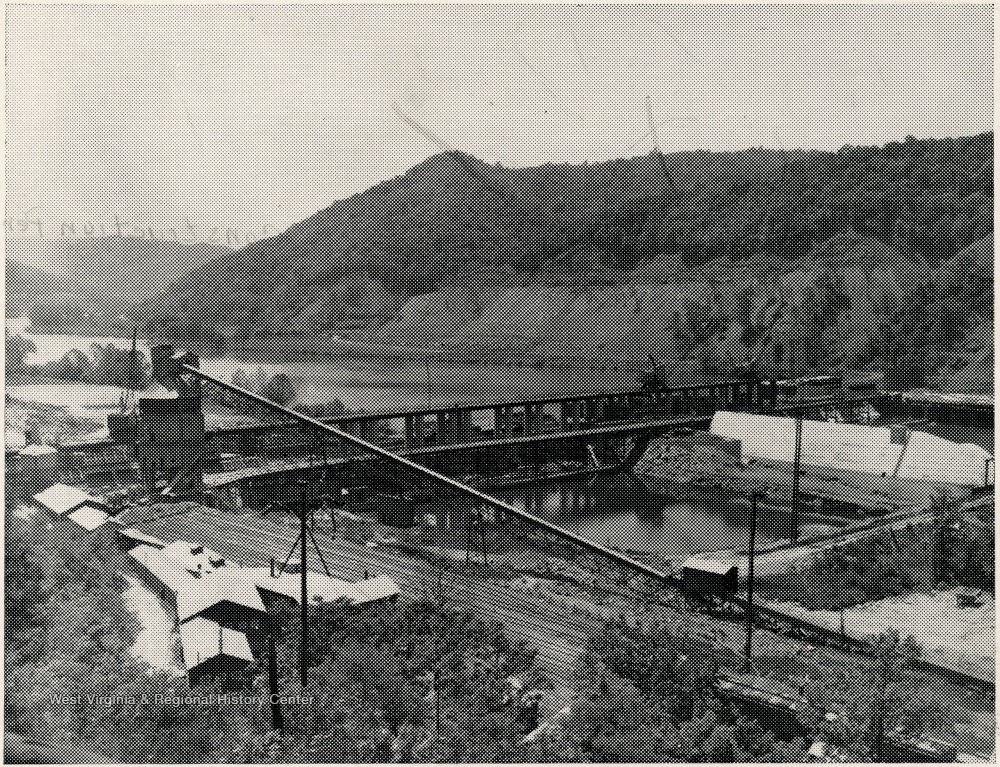 |
| Bluestone Damn Construction |

 |
| Paul the thin man on the left with Ranny and Jack. Circa 1939. Looks like it was taken at a river camp. Do not know The little girl or man. |


 |
| 30th Anniversary Picture 1963 |
Moving Back to Hungards Creek
As previously mentioned, my grandparents never settled in one place or owned a home. Their prospects changed during the early sixties when Paul's older brother, Emmett, approached them about purchasing the family farm on Hungards Creek. The details of the transaction are described more fully in the post about my Aunt Faye. With the help of my father and my Uncle Jack, they were able to purchase the 137 acre (more or less) farm for $6000.00. Each owned a third interest in it. With this development, my grandparents began to think of having their permanent residence there. While it was occupied by Aunt Faye and her partner Danese Haynes, the home was not quite as modern as their city dwelling. Work would be necessary to bring the home to modern standards.

Here is the farmhouse circa 1950. Unfortunately, the details on the pictures are not clear enough to recognize faces. The iteration of the home had a upper level porch in the front, and one in back as well. On my first visits in the early 60's, I vaguely remember black walnuts drying on the upper level back porch. It had phone service and electricity, but no indoor plumbing. The outhouse in to the left of the home. Water came into the kitchen using a hand pump to move water from a spring that runs out of the base of the mountain behind the home. It is very good water too, without sulphur or iron as many local springs have.

The spring house. Inside was a catch basin made of rock and mortar which sequestered a pool of cold spring water which emerged from the base of hillside and probably traveled a fair amount of distance from the higher mountains above it. It is good water and never ran out during dry periods.
I am guessing that sometime in 1967 Aunt Faye and Danese left the farm for a home and Talcott and Paul and Maycle began their renovations. Big changes were made to the home. The upper porch and entrance to it was eliminated, as was the upper level back porch. Plumbing was added to the kitchen and an entire bathroom was added under the area where the original upper back porch/deck was. The electrical service was upgraded to allow the modernization of the kitchen which previously had a wood cook stove and hand pump for water.
 |
| Circa 1969 after paint and renovation. Paul and Maycle had moved in. |
The image to the left shows the front of the home with the upper deck porch removed and the new front porch constructed, but with out rails. The home had been painted for the first time in decades. The bathroom had been completed and a new septic field was also dug for drainage. The home got modern upgrades, and as far as I know, all of the plumbing, carpentry and electrical work was done by my grandfather with occasional help from my Uncle Jack and my own father. It was a substantial undertaking but also done at a time when the old wooden structure needed lots of attention. The most fortunate aspect of the original construction was a thick metal rood which prevented destructive water damage and preserved the original wood.

The modernized home circa 1987.
In talking with my Grandmother she once said she thought the period where the moved to farm was the happiest in their lives. Granpa was still working, their health was still good, and they really loved the aspects of farm life that was most like what they remembered growing up. They were back to the land people before hippies became synonymous with the movement. The main difference is that actually had the knowledge and skills necessary to successfully live on a farm.
Food and Gardens and Raising Food
Many of the years they lived in Hinton, they often had kept a garden on the farm, but now that they were living there, they expanded their cultivation to best meet their annual food needs. Appalachian people ate a lot of beans and the half runner became their go to canning bean. They planted garden peas for an early summer crop, but generally ate most of those as they came in, typically creamed. At the same time they would have some salad greens of some type and green onions and my grandmother made a wilted lettuce salad that I would serve in any restaurant. It included salty rendered bacon fat, bacon, vinegar and sugar, which made it sweet and sour, green onions and fresh green tender lettuce. If Grampa looked around, he either could pick ramps on the farm buy them from someone else. He seemed to like'm but would joke about how badly they made your breath smell.
After the early season vegetables, they got summer squash and early new potatoes and bigger kinds of onions, red and white varieties As it got hotter into July and August, harvested several kinds of tomatoes, loved silver queen corn and always had bell peppers. They made dill pickles with their own dill and cucumbers, and raised delicious cantaloupes and watermelons. They raised beets and served them with dinner. As a ten year old, I discovered I liked them and ate more than my share. The next day I was certain that I was going perish from a massive digestive hemorrhage as evidenced by what appeared to be a bucket of blood in the toilet from my regular morning bowel clearing. I was seriously worried and beckoned my grandmother to come see before I bled out. She laughed at me and suggested that as I otherwise looked pain free, healthy and fine, the beets were likely the cause. Made sense.
They also propagated berries of various types. Granpa had two different kinds of raspberries for a few years and the strawberry patch provided the sweetest of all the garden treats. He also ordered thornless blackberry vines. The fresh berries were used to make old fashioned desserts. Raspberries and blackberries were easily turned into simple cobblers, often served with ice cream or half and half. Strawberries with sugar on them became the syrupy topping to shortcake with whipped cream. She had several different pairings of berries which included homemade custard, or a thicker pudding. They often made a banana pudding for my father during our visits. While many banana pudding recipes rely on packaged pudding, by grandmother or Aunt Willie would make an old fashioned butterscotch pudding as the fill.
My grandfather really loved sweet things and these kind of desserts were his favorite.
I would have to mention homemade ice cream because this was often made and served. For some reason it was called "Granpa's Ice Cream", which made is sound like he was mostly responsible for its manufacture. There was a short period on the farm where it did require some effort on Granpa's part because it involved the tedious turning of a hand cranked churn. It took a long time and a good deal of effort. That aspect of it changed when they hooked an electric motor to the churn and that part of the process was made far easier. They still called it "Granpa's Ice Cream", but 98% of the effort was in the kitchen, not at the ice cream churn. Homemade ice cream is really good, but Grama had found a recipe that was especially rich as it was based on a custard which she frequently made. This is real close approximation of the recipe. If anything is short, it is the amount of sugar, they ate a lot of it.
2 Cups of heavy cream
1 can Eagle Brand Condensed Milk
2/3 Cup of sugar (more sugar gets added with the fruit)
6 large egg yolks
Pinch of salt
Flavor of Choice
First make custard with these ingredients, which generally means mixing them well and heating until the mixture thickens. The Custard then sits in the refrigerator till it cools, generally Grama had this made the night before it stayed in the fridge overnight.
If they used fresh fruit or berries, they would crush several cups and sugar to the fruit and mix it in before churning. They liked everything, but fresh peach was especially tasty. Granpa really liked lemon but would get excited about the prospect of any of it.
The other sweet that my Grandfather could not get enough of was maple syrup. Upon moving back to the farm and just after retirement they undertook a season of maple syrup production. The hillsides had plenty of sugar trees to tap, and grandpa did so and brought all the sap to a central location where it was boiled, allowing the water to vaporize and leaving behind maple flavored sugar. They boiled down to a syrup. One two occasions they drove to Highland County which celebrates a maple sugar heritage, and left will all kinds of sweets maple treats. They processed some of their sap down into maple candy, which my grandfather adored.
They grew enough potatoes to last all winter and stored them in the bottom of the smoke house behind the main home. Appalachian people like their gardens and Granpa loved to show his friends what kind of things he was able to produce. I remember digging a few potatoes with him and how excited he got about finding some extra jumbo taters in the dirt. He picked enough to feed the preacher and his wife who were invited to dinner but left the big ones out so preacher Dameron could see what kind of tater farmer he was. It ain't brag'n if its true.
The current marketing strategy for US produce seems hold the organic label in high esteem. This was not true in the 50's and 60's and really only came onto the consumer radar in the 1970's where "all natural' or "organic" became the marketing standard. Paul was not by any means an organic gardener. If fact, people who really depended on growing their own food were more than happy to purchase pesticide products to mitigate the impact of insects on their produce. I'm pretty sure that a lot of DDT was used in the 50's and he regularly dusted all the leafy crops like beans with Sevin powder. Everyone did. If you drove by a garden, all of it would have have the dust of pesticide on it. He used commercial insecticide sprays as well. Let's just say that before anyone started actually looking into how pesticides affect ecosystems and human biology, they were enthusiastic about using these products.
We have to imagine the time and effort it took for farm families to put food products on their table. It involves the cultivation and tilling of earth, planting, maintaining the garden, harvesting and processing the food. That's just a garden. There was also livestock. A milk cow as a valuable animal for sustenance, but cheese, butter, buttermilk and cream all required addition processing, and all of that was work, sometimes very hard work. We tend to look at that as the idyllic life of the small American farm. When work saving devices or processes became available, they were more than happy to trade in some back breaking process for a new tool or procedure. Margarine is an example. For centuries people had churned milk and separated the fat and solids from it to make butter. In the late 40' and early 50's margarine became a cheap substitute fat for butter. You could purchase a pounds of it for a reasonable price and all you had to do was stir in a dye packet to make it look like real butter. It worked as butter substitute in recipes and at the dinner table. My father said that his grandmother, Carrie, once said that "margarine makes a cow ashamed of itself". The family butter churn got painted as curiosity and used to decorate a corner of the dining room.
However, Paul and Maycle preferred the old fashioned butter and could still find people who made traditional Appalachian dairy products and always had them on hand when I visited. Appalachia is not know for any kind of cheese production but the one variety the often had was a dry curd cottage cheese. It was a light yellow in color, dry and have very little whey. They also found "country butter" which was probably a 2 or 3 pound hunk of butter poured into a mold. It had a lot more flavor than butter that was produced by industrial processing and they would let me eat slices of it. I have not seen or tasted this this for decades.
They always had couple of cows, a pig, generally named Arnold because all pigs became Arnold after Green Acres came on the TV. Nothing gets more bang for the livestock buck than chickens, so they had nice coup of hens which provided plenty of eggs. While they might actually kill their own livestock, they would take it to someone local for processing. Granpa really liked pork and occasionally salted and cured his own hams. He adored country ham, and though he never heard of prosciutto, that is the country ham thickness of his dreams. I have seen him mildly irritated when his ham was cut too thick. When they had a ham, he could eat it every day till it was gone.
 |
| Sausage sealed in Pork Fat |
They would also grind up other parts of hog and make a heavily favored with sage and salted sausage shaped into small patties, which were fried, and them put into mason jars and sealed with a layer of lard and the jar lid and ring. It kept well that way and was easy to heat up for breakfast. It is classic Appalachian sausage and it's how I always now imagine how sausage is supposed to taste.
There were several things unique about my grandmother's dinner table which are well remembered. She frequently baked homemade light bread as part of meal. It was soft and yeasty and the smell of baking made you want to sit in kitchen. That bread. with a hunk of country butter and any number of jams, jellies or honey was sublime. For special occasions, she had yeast rolls which were just as yummy. She also always had rhubarb on the table, which she boiled down and to which she added a couple drops of red food coloring and as much sugar as could dissolve into it. You could eat on bread, or just as sweet side with the rest of the food. There was also always had raw vegetables like radishes or slices of green or yellow bell pepper.
Farm Work
The farm revolution took place during my granparent's lives. They still used horses and mules for many farm tasks and in the lumber business. The steam saw mill which provided income for a couple decades on the farm gave out, and given that most of the marketable timber in the region had been cut, there was no longer any need for a big steam engine to power a saw. Enter the internal combustion engine and farm machines which used gasoline.
Paul learned to drive on a Model T. As he told it, they just took it to the big cow pasture which was across the creek from the farmhouse and practiced until he got to where he good drive the thing. He also experienced horse drawn transportation and could set up a two horse hitch for plowing or wagon work. He liked horses and talked frequently about using them for work on the farm when he was boy. My own father aspired to resurrect the use of horses for agriculture and acquired draft horses on his small farm in Faquier County, Virginia.
They kept an ancient unlicensed pick up truck in one of the outbuildings and used it to haul whatever needed to be picked up and hauled. They had a 1950's vintage Farmall Tractor. One year, before, they had actually moved in to the farmhouse, they cut and put up many bales of hay. As five year old, I thought that was the best day ever. I got to ride in the front seat while grown men picked up heavy bales and carefully staked them into the back of the truck. Then it was loaded in to the barn, which was an even better place to play. You could arrange the bails in to tunnels and mazes.
It wasn't nearly as fun in years hence in which I also had to pick up those bales and carefully stack them. Granpa fretted about putting up hay cause the whole enterprise could be easily ruined by unwanted rain. They did their best with the weather forecast but a series of spring thunderstorms could interrupt the process and make it difficult to get dry hay into the barn. If it was the least bit wet, grandpa would worry about the bales composting in the barn and possibly reaching a temperature which could cause a fire. Those are the kinds of things that kept him up a night.
Paul was a pretty good mechanic and took good care of his equipment. The problem early on was that most of his stuff had seen way better days. He had a collection of 2 cycle lawn mowers that were most likely manufactured right after WW2. They used a fuel and oil mixture and he, and only he, know how to get the things to run. The problem was that the grass was really thick and lush and it was real easy to bog down one of these old machines and have it stall. Then it was really hard to get'm going again. Consequently, grass cutting day was hard work and likely to produce some cursing and displeasure.
Eventually, my Uncle Jack brought a riding lawnmower to the farm and they upgraded the push mowers to models that were self propelled. It was also the dawn of my grandfathers favorite yard tool, the Weed Eater. He loved that thing. Compared to the scythe implements and hand trimming sheers , the weed eater was a vast improvement in effort and time. With a blade attachment, one could make short work creek bank clearing or brushy areas.
In the early 1980's they had a heifer and wished to have it bred. In the old days, the local bull would take care of it, but bulls had become few and artificial insemination had become the standard for creating calves. Grandpa correctly observed the change in his heifer which indicated she was coming into heat and wondered aloud if he should call the guy who had all the tools for the artificial insemination. Problem was, he could not pronounce "artificial insemination" and was not comfortable asking for such a service. After verbally ruminating and generally dropping hints about wanting it done, by grandmother finally just sail "Paul, do you want me to call the man?". Of course he did, but she also could not pronounce "artificial insemination" either and also wasn't particularly comfortable talking about it. I volunteered to help as I could pronounce artificial insemination and I had no qualms asking for such a service. It was was easily and quickly arranged and the man showed up with his tools the next day.
There really wasn't much to it. A semen sample pulled from a liquid nitrogen Dewar was placed in to the tip of a long applicator, which was inserted through the cows vagina and deposited somewhere near its cervix. I was given the job making sure the cow didn't turn its head and was directed to put thumb and index finger into the cow's nose as if I could fashion a temporary nose ring. The cow , not particularly happy about any of the activity on either end, and bellowed in disapproval. It also started using its big ole tongue to try displace my hand, which was become covered with cow snot. None of this lasted too long and the end result was a pregnant heifer. I was glad to help'm with it, but not entirely sure that putting my fingers in the cow's nose was necessary.
When I was in the first grade, I was excited to hear that they had acquired a pony which they hoped grandchildren would enjoy. I recall that this pony was named Astronaut, after all, it was the early 1960's and we were in the space age. I eagerly awaited our first trip back to Hinton and a trip to the farm to ride on Astronaut. Alas, it turned out that Astronaut was pretty good at pulling logs and things, but had zero tolerance for having anyone on his back. Granpa had the pony in a barn stall, saddled, and just to show who was boss, mounted the little steed. It did not go well. Astronaut bucked hard and the kicking hooves split to old oak railing in the stall and sent grandpa into orbit. There was elaborate cursing and hard feelings. It aggravated a hernia grandpa was nursing had and he had to wear truss for a while. Astronaut was replaced by Cannonball, who was a very placid and compliant pony who was fine around kids.

My sister, Carrie on the nice pony, Canonball in 1969 on the farm at Hungards Creek

Me on Grandpa's horse, Apache. That's our '66 Chevy Bel Air in the background.
Aunt Willie
 |
| Willie Benton Light, me and my sister in her and her mom's apartment in Hinton. 1969 |
After Grama's Ada's death, my grandmother and grandfather didn't think twice about inviting Aunt Willie to live with them on the farm. She accepted the invitation and moved into the newly renovated farm house and occupied a big bedroom in the upstairs front of the home. If Paul thought he had it good with Maycle taking care of him, it got even better with additional help in the house. She helped clean, cook and would never, ever, let your sweet tea glass get empty at the dinner table. She continued to work, and found rides into Hinton to continue her employment at GC Murphy's. There were several summer's when my sister and I stayed on the farm with my grandparents as my own parents traveled. Willie's contribution to my own happiness included bringing unsold and out of date comic books to the farm for us to read. They always had half of the front cover torn off, but I spent many any a summer afternoon with Sergeant Rock, Spider Man and The Fantastic 4 when the ladies were watching their soap opera on the TV.
The TV
The TV was a constant struggle. Living in Hinton, my grandparents actually had access to an early kind of cable which provided all three of the existing networks with a clear picture. Such technology was not available in the Hungards Creek valley. What ever scant electromagnetic waves that could be captured had to be done with an antenna. Problem was, most of the signals did not make it down into the valley, which meant one had to hunt the ridges for them.
Hunt we did. My grandfather knew a man who had a 1970's vintage signal finder which consisted of a heavy but portable box in with very small picture tube within. The idea was you could walk around a property and view the picture tube which would display a TV picture if the signal was strong enough. That's where an antenna would go. I got to search with him one time and it involved a good deal of walking on hillsides without much luck. He did finally settle on location which had good signal from the Roanoke and Bluefield broadcasts, but it was across a road and at the top of the mountain. Google Earth says 600 linear feet from the house with an elevation change of about 300 feet.
Grandpa carried a big ass TV antenna to the top of the mountain, in the middle of forest, and the strung Antenna wire down and into the house. For that effort he got one reliable channel from Bluefield and sometimes got Roanoke. It was still a pain in the butt, because the antenna wire stretched through several hundred feet of woods, and any time a storm came through, limbs and sticks would fall on the antenna line and disrupt their service. He would then have to climb the steepest hillside on the property to find the breaks was and splice it. This was a common activity but there were rewarded with Hee Haw and Tiny Thompson reading the Bluefield (WHIS) news. Tiny kind of talked out of the side of his mouth, which I commented on, and was informed by my grandfather that Tiny was "jimmer jawed". That explained it all.
Years after they left the problem of finding TV signals was resolved with satellite dish reception. Because of West Virginia's mountainous terrain, most areas have challenges with antenna based reception but if you have clear spot to the sky you could pick up the direct transmission of satellite feeds which were, by then, the standard technology for communications. It was joked that the State Flower of West Virginia had become the satellite dish.
Like his lawnmowers, only grandpa had the arcane knowledge of how to get the TV to work properly. He put some electric throw switches mounted on the back of the TV, presumably they somehow differentiated between the Roanoke and Bluefield signals. All in all, they got enough signal watch to one reliable channel in a snow storm and if the gods of the electromagnetic waves smiled on them, they could pull in a similar signal from Roanoke. In the summer of 1973 President Nixon was in hot water over his alleged knowledge and approval of nefarious deeds done for political advantage involving a botched burglary in his political opponents office in the Watergate building. Senate hearings investigating the matter were televised and I remember watching in July of that year. Senator Sam Ervin, and country lawyer from North Carolina chaired the hearings and I can still remember his deep southern drawl and how he typically dismissed the committee for breaks by saying " I can tell by the clock on the wall". Even with one or two channels, the farm was way more connected than it had been for previous generations.
Church and Preachers
Methodism is a prominent denomination in the southern West Virginia as Methodist circuit riders were among the first ministers to settle and evangelize in the region. It is the Methodist mandate to spread the gospel in the back country and this accounts for the establishment of many small, rural Methodist churches. Paul, Maycle and Willie generally worshiped at the Hinton United Methodist church when they lived in town. The attended Sunday School and worship services at a time when the Men's Sunday School and Women's Sunday school were segregated by sex. My grandmother's Sunday School class lead by Addie Gooch, apparently a single woman and grand matron of decades of Sunday School instruction. Addie left grama a beautiful quilt when she passed, but the preacher and his wife got most of Addie's stuff which raised some eyebrows.
Maycle and Paul made it a point to be good friends with the church ministers and developed some lasting friendships with them. Preacher Dameron and his wife were frequent visitors to the dinner table and Preacher Dameron often wrote and shared poems about Paul and his garden and shared them during his visits. My grandfather honestly thought that currying favor with ministers was also getting a little closer to God, and one could possibly play that hand into better chances for salvation, if not some favorable outcome of prayer, rain for the garden, for instance. He told me he got good rain on the farm cause they fed the preacher.
The continued to drive to Hinton for Sunday worship when they moved to the farm, but at some point decided that attending church and Mt. Pisgah in Hilldale was a bit more convenient. This church had been attended by many Scott's living in Talcott and many are buried in the church cemetery on this site My grandfather's Uncle's family, James W. Scott, whose descendants included William Lloyd Scott who became a US Congressman and Senator from Virginia.
Their roots in Methodism and the sentiments of the time period might have contributed to their sensibilities about the consumption of alcohol. Methodist preachers would actively speak against any consumption of anything with alcohol in it. The common assumption was that once you started down that path it would become a slippery slope of idle drunkenness. Historically, there were big problems with alcohol in rural communities where it was distilled and abused. I never, ever, knew my grandmother or Aunt to consume anything with alcohol in it. My grandfather would occasionally have a glass of cider that turned hard. A doctor once told him it would be good for him to have a beer because it would thin his blood, but a six pack of Miller High Life would languish in the fridge for months. Although there is ample evidence that previous generations used alcohol, my grandparents were not drinkers.


Maycle, was very good with needle crafts and knitting. We call it a side gig now, but in her day it was her way of making a few extra dollars by putting her craft talent to good use. Her most successful product was the Mr. and Mrs. Santa doll set pictured below. I think she got the idea out of magazine, and ran with the concept. I don't how many sets she produced, but it was enough to earn her some extra cash and she was proud of it. I think the base on which everything hangs are old Chlorox bottles. She would work on these all year long to have them ready to sell by the Christmas season. This is pair belongs to my cousin, Jack Scott and his wife, Kristi. Mr sister, Carrie had a pair but they fell apart after several moves. These are still pristine.

Tribulation and Sadness
In my own mind, the death of a child in among the most difficult events to endure, but seeing your eldest adult child go to a grave before your own passing is particularly wrenching. My own father developed an aggressive and rare form of cancer called a high grade mucoepidermoid carcinoma. I always suspected that Dad's incessant tobacco chewing might have contributed to its origin, but there is no link between that particular cancer and tobacco. Bad Luck. Cancer is scary now, and it was scarier then. He got the whole trifecta of surgery, chem and radiation at a site where part of this jaw and all of the lymph nodes were removed. and it was not clear to us then, but I had access to his medical records when I worked in Radiological Physics at the University of Virginia Medical Center and the cancer had already spread away from the primary site. He then had chemotherapy and radiation. It was a really tough and debilitating treatment but upon completion and recovery, he had some good health and good times for a few months. He played farmer with his big horses at their home in Fauquier County and was happy. It didn't last as the aggressive tumors found other spots in his body to cause pain and misery. He passed away in October of 1983. He was 49 years old.
I was working in Colorado, but had traveled back to Virginia for a couple of weeks to help mom with his care, which mostly involved keeping up with his pain meds. I went back to Colorado knowing that I would probably not see him alive again. A week later, in the midst of my sleep I dreamed of him. He came to me and in a solemn and serious tone told me that he was very disappointed about it, but he could no longer live on earth, and it was time for him to leave this world. My dream was then interrupted by an early morning phone call from my mother to tell me that he had passed. I knew that was going to be devastating to my grand parents but wanted them to hear it from me so I called them and let them know. The absolutely wailed in grief, but I think by that time everyone was glad that he was no longer suffering. It was a terrible disease.
Health
My grandmother was diagnosed with Type 2 diabetes in the middle 1960's and began using insulin at that time. It was a challenge for her as she was the cook and also liked sweet foods and desserts. She constantly worried about her sugar levels and that would often be the first bit of information dispensed in the morning. "My sugar is up to 300", she might say, and always seemed very worried about it. Despite that, she lived into her 80's and managed to avoid circulatory problems which could have affected her feet. She was plagued by aches and pains, most notably her hip and back. By and large, her mind did well until the last year or so of her life. The last time I saw her, she was pleasant, enjoyed or visit, but really didn't know who I was.
My grandfather's health was largely influenced by smoking. He started when he was 12 or 13 and cigarettes were his constant companion. He would have smoked in his sleep if he could have figured out how to hold'm. There were more than a few decorative household items that were obtained from coupons obtained from Raleigh Filter cartons.
In the early 1970's he had chest x-ray and the doctor told him he had emphysema. He quit cigarettes that day. He took up a pipe for a while, didn't inhale, and quit that after a while. That, at least, stopped the damage from progressing, but much had already been done. His lungs where not good. I remember him waking up, sitting on the side of bed and hacking, coughing and spitting for five minutes before he could get going with the day. In the mid 1980's, he become more and more sedentary, which did not help with his breathing issues. I brought this to his attention and he said he didn't care if sat down most of the day because he had worked hard all of his life and even worked in places where it was so cold that lunch froze. He was glad to be able to relax and have Maycle and Willie wait hand and foot on him.
Ultimately, it was his lungs that made his life difficult. Having them damaged and being sedentary made it more likely that he would contract lung infections that this was the case. Each winter brought the prospect of colds, flu and pneumonia. In the winter of 1987 or so, he was really struggling with respiratory issues was very sick. My Uncle Steve recalled that her heard him yell out "I'm Gone!, I'm Gone!" and found him struggling to breath on their living room sofa. They took to him Hinton and with treatment he recovered. But it made clear that they were living in a rural place and medical help was not close by for such emergencies. Doctor's were people they saw frequently at this point in their lives.
They began to worry about being elderly and their safety. Although mostly left alone everyday, from time to time people would run out of gas and knock on their door for assistance. They would be glad to help if it seemed like a legitimate request, but sometimes it was not. Granpa had a street lamp installed on a electrical pole in the front yard so they could better see what was going on at night. One night they were awakened by a knock on the door and man they didn't know, and who didn't look like a good citizen He had run out gas and wanted Granpa to give him some. Being it was late at night, and that the guy seemed like he might be drunk, Granpa declined and sent him on his way. He locked the doors and hoped that would be the end of it.
It wasn't. Apparently the man thought he could break into the tractor barn where there might be gasoline and was attempting to remove siding boards from said tractor barn, making an audible racket in the pursuit thereof. This was troubling, and a bit frightening to all occupants of the house so Granpa decided an airborne blast with the 20 gauge would be an appropriate escalation in an attempt to dissuade the would be gas thief. He opened the front door, went out to the front sidewalk and discharged the gun into to night sky. Unfortunately, the electrical wire carrying current to the streetlight was directly between the blast and the dark infinite heavens and was severed by the blast. The front yard was also plunged into darkness. I'm not even sure if the thief left. Granpa would just have soon forgotten that story.
Given their circumstances, they began to think about leaving the farm and moving to town where they would be closer to medical services and where the maintenance on their home would be less stressful. This did not come to fruition in their first talks about it as real estate sales and buyers were very scarce at that time. But I knew it was a possibility that the property could soon be gone and made every effort to spend time there while it was in family hands. When my daughter was born in 1986, we took her there as an infant and visited frequently.

This image is of my Maycle and Will playing pee-a-boo with my daughter, Michaela in March or April of 1986. This is in the kitchen of the farmhouse.
Eventually all the pieces fell into place for them to relocated back to town. Their physician owned a home in Hinton, his office actually, right next to the Methodist Church and its price was perfect for my grandparents share of the sale at the asking price. In 1987, the 136 acres sold for $90,000, which seemed like a fortune compared to the $6000.00 it cost in 1962. They moved back to Hinton in a stately classic old home right next to church they had attended their whole lives. They had cable TV too, and the programming was displayed clear and bright on their massive console color TV, and did not every require rigorous hillside ascents after storms.
They had some good years there. They had the general problems of old age, but life was easier for them. They were also closer to my Uncle Jack and Aunt Donna who helped them keep their pills straight and took care of many of the day to day things that hand become difficult for them. When Paul was diagnosed with prostate cancer, Uncle Jack drove him to Beckley for his radiation treatments. In this case, Paul had been diligent about having regular checkups. The disease was found early after a PSA test raised suspicions and the treatment involved lots of trips for radiation, but did not cause him too much distress. His doctor assured him that it was not going to be deadly and he tolerated the treatments and recoverd well.
As I was raising my own family, I had hoped my grandparents would be able to enjoy seeing the next generation begin.


Paul, with my daughter, Michaela, same time period.

Paul with baby Conor.
My grandfather's family had maintained a Memorial Day family reunion for decades. This image shows all of my grandfather's brothers and sisters around 1957 or 1958, the last year they were all alive. They had all been children on the farm and gathered there each year. I could walk right to the spot in the yard were it was taken. Of course as time when on these people passed away and our family groups became smaller. The children above where from two mothers, Elizabeth Agnes Boyd, and Roberta Caroline Mann. Their father was Green Lee Scott.

The Picture below are the descendants of Paul and Maycle Scott In 1990 or so, less my dad who is deceased. It was taken at Jack and Kristi Scott's hill top home in Marie.

1991 was a hard year from Paul Scott. He had gotten through his cancer treatments but his lungs were not well. I had moved to Ferrum Va with my young family and after a nearly snowless winter, I awoke to a early April snow and a phone call from my Uncle who said Granpa had been hospitalized with double pneumonia and was not doing well. I hoped in my Subaru wagon and found the 4 wheel drive feature to pretty handy as I had to cross the Blue Ridge and New River Valleys in heavy snow.
I arrived at the hospital and found Uncle Jack with Granpa. We talked and visited and he fell to a sleep. My Uncle and I then went to his home where I visited with my Aunt Donna as well. As we sat and talked about Granpa's prospects the hospital nurse called and indicated that Paul had begun to struggle with breathing and it would probably be a good time to be with him. We found him gasping for breath and seemingly not aware of any of his surroundings or the people around him. I had worked in a hospital and had seen people breath in this manner before they passed. We sat by his bed for a long time and watched him struggle. I had not intended to stay, and I needed to be home for child care so my wife could attend to her brand new job. I returned home and awaited the inevitable phone which would confirm Paul's passing.
It never came. I waited till about ten in the morning, called my Uncle Jack and\ was informed that Granpa survived the night, was sitting up and having hot oatmeal for breakfast and wondered where I gone.
He actually died in on December 1st of 1992, about 8 months after I was pretty sure he was gone. In the end, he was again hospitalized and died very quickly, probably from a heart attack and with a doctor standing right next to him. He was 81 years old.
This left my Grandmother and Aunt Willie in the home, and their health had also begun to decline. Aunt Willie was always really physically very healthy. Her aches and pains were minimal, or at least she never complained about much. She had no bad habits, but, Alas, she did have bad luck with dementia. It is such a sad thing to see someone loose their bearings and have their mind make them so confused. Ultimately, she was cared for by my Uncle Steve and his wife Tamara. The last time I saw her, she didn't know who I was. She died in July of 1996 while my family was traveling across the Unites States and I did not attend her funeral.
My grandmother lived with my Uncle Jack and Aunt Donna for a period of time. They had a nice space for her took great care of her. She had always had aches and pains and became physically disabled to the point where she needed help with all of her movement. Ultimately, she decided that given her situation, it might be better to be where she had full time nursing care. When a spot opened up at the nursing home at the hospital, she opted for that. As time went on, her mind also lapsed, but her pleasant nature never, ever left. The last time I spoke with her, she did not know who I was, but was happy I stopped by and seemed to enjoy our conversation.
My Uncle Jack and Aunt Donna were so caring and helpful to them at the end of their lives. They took such good care of them.
Our family is buried in the Oak Grove Cemetery which is a scenic hilltop between he small communities of Talcott and Marie. It is a pleasant place to visit and I always feel at peace when I remember my family there.

The Manhattan Project:
https://www.osti.gov/opennet/manhattan-project-history/index.htm
https://archive.curbed.com/2018/5/8/17328702/secret-cities-national-building-museum


Comments
Post a Comment
Always post responsibly. This is a comment moderated blog